

Accessible Science
Keeping Alive the "Wow!"
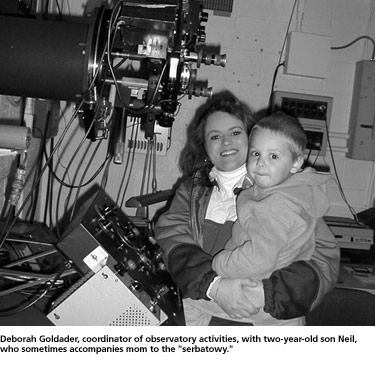
"The first thing everybody says when they get to the Flower and Cook
Observatory is, 'Wow, look at how many stars there are!'" The remark
is from Deborah Goldader, coordinator for the university's aging observatory,
which is situated just beyond Philadelphia's urban glare. "Most students
who come to Penn have never been out in the country," she asserts.
"You can't be inspired to write wonderful poems about the starry
night sky, if you can't see it. Children can't look up and have that feeling
of awe."
Sower of Science
Goldader teaches Astronomy 150, a course for non-science majors that blends
a survey of the subject matter with intense work on observational technique.
This is in addition to procuring flashlights, chairs, and equipment for
the observatory's telescopes; running programs for visiting groups of
school children, scouts, and campers; and generally dreaming up and scheduling
observatory projects for Penn's astronomy classes.
The Flower and Cook observatory is no longer a major research facility, although it continues to play an important part in teaching and public outreach. Much of the cutting-edge astronomical research is conducted remotely. Scientists analyze data in their offices after it's been collected by mostly automated systems and technology attendants. It's a "disconnect" between astronomy and the sky that Goldader admits has been productive in terms of new knowledge, but she still finds it troubling.
 The
observatory's main telescope, a 28.5-inch reflector, was built in the
1930s, but it remains functional and is probably the biggest, most impressive
scientific instrument most people will ever get to handle. "The tube
is about 15 feet long and weighs several tons," she explains. "Students
[and visitors] get it in their hands; they swing it around; they point
it at the sky to a spot that's maybe the size of the eye on a dime, and
they can see deeply into that little speck of the universe." Goldader
wants her students to be able to read critically and with understanding
the astronomy articles in the New York Times science section. A
hands-on familiarity with the night sky helps make the theoretical lessons
of the classroom more solid.
The
observatory's main telescope, a 28.5-inch reflector, was built in the
1930s, but it remains functional and is probably the biggest, most impressive
scientific instrument most people will ever get to handle. "The tube
is about 15 feet long and weighs several tons," she explains. "Students
[and visitors] get it in their hands; they swing it around; they point
it at the sky to a spot that's maybe the size of the eye on a dime, and
they can see deeply into that little speck of the universe." Goldader
wants her students to be able to read critically and with understanding
the astronomy articles in the New York Times science section. A
hands-on familiarity with the night sky helps make the theoretical lessons
of the classroom more solid.
To remain credible, she argues, a research university needs to hold open this kind of tangible and approachable glimpse into the knowledge it generates. "If you publish things that the public is out of touch with, they won't believe it, or they will have no basis on which to judge it." And, she adds, as taxpaying voters, they won't support what they don't understand because they won't think it's important.
Seeds of Wonder
Even before being enthralled as a fourth grader by Carl Sagan's TV series,
Cosmos, Goldader built an eclipse in a shoebox. The smell of the
black paint that darkened the inside is still with her. She cut a hole
for a flashlight and suspended two balls so the shadow of one fell across
the other. Later, she earned a master's degree in astronomy from the University
of Hawaii and completed her Ph.D. coursework, but has now switched directions
on her career path. She's taking courses in the Graduate School of Education
to obtain secondary school certification for teaching science.
"I realized, as I was getting through my thesis, that somebody else is going to figure out the infrared properties of interacting galaxies in clusters," she remarks. In a technological society, where science is an important part of life, she believes we need teachers who've done research and "really, really, really understand" it—teachers who've taken science in their hands, swung it around, and pointed it at the sky. "Science isn't magic," she insists, "it's a method." Well, maybe.
Many of her Astro 150 students returned to her office this fall to let her know how they'd spent the summer in India or France or Yellowstone Park. They told her how they'd found themselves talking casually about the wonders of the universe, drawing on the science they'd learned in her class.
"To be able to sow those seeds and have them bear fruit all over the place is a much richer way for me to spend my life," says the purveyor of science and awe. "For the students to come back and tell me that they talked to others about astronomy while kickin' back a beer under a dark night sky at Yellowstone. . . .Wow!"
For more information about the Flower and Cook Observatory and its public nights, visit the Penn observatories website.