Thinking
Thinking is the attempt to resolve doubt about:
- Actions (decisions, options)
- Goals (values, objectives)
- Beliefs
- Diagnosis
- Hypothesis testing
- Learning
Thinking is one determinant of actions. Others are learning,
reflexes, and emotions.
Thinking = search + inference
Search for:
- possibilities
- evidence
- goals
Diagram of the search-inference framework
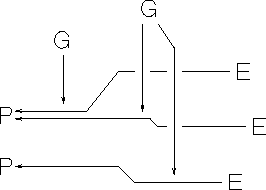
Example: Iraq war
Getting into the war
Surge
An example of a bias: Outcome bias
A fault condemned but seldom avoided is the evaluation of the
intention of an act in terms of the act's outcome. An agent who
acted as wisely as the foreseeable circumstances permitted is
censured for the ill-effects which come to pass through chance or
through malicious opposition or through unforeseeable
circumstances. Men desire to be fortunate as much as they desire
to be wise, but yet they fail to discriminate between fortune and
wisdom or between misfortune and guilt (Arnauld, 1662/1964,
p. 285)
Item used by Baron and Hershey (1988)
A 55 year old man had a heart condition. He had to stop working
because of chest pain. He enjoyed his work and did not want to
stop. His pain also interfered with other things, such as travel
and recreation.
A type of bypass operation would relieve his pain and increase
his life expectancy from age 65 to age 70. However, 8% of the
people who have this operation die from the operation
itself.
His physician decided to go ahead with the operation. The
operation succeeded.
Evaluate the physician's decision to go ahead with the
operation.
Another item
A 25-year-old man is unmarried and has a steady job. He receives
a letter inviting him to visit Quiet Pond Cottages, where he has
been considering buying some property. As a prize for visiting
the property, he is given a choice between:
Option 1. $200.
Option 2. An 80% chance of winning $300 and a 20% chance of
winning nothing.
He must mail in his decision in advance, and he will be told
the outcome of Option 2 whether he chooses it or not.`
Design issues
Normative model: what subjects think vs. independence of outcome
Within-S transparent vs. within-S hidden vs. between-S
Types of models
- Normative
- Standard for evaluation
- What is the right answer for this task? Why?
- Descriptive
- Psychological explanation of departure from normative
- Heuristics, strategies, mathematical models, perceptual principles,
mental models
- "Bias" = systematic and non-normative
- Prescriptive
- Advice or prescription: heuristics, decision analysis
- Designed to increase evaluation by normative standard
- "Irrational" = departure from prescriptive?
Other normative models of inference:
- logic
- probability theory
- utility theory
Summary
Normative models are standards:
- Probability, statistics, utility theory
Descriptive models take several approaches:
- Heuristics, mental models, naive theories
Prescriptive models are addressed to different audiences:
- Decision makers, policy makers, teachers, programmers
Example of Polya's heuristic methods
x
4 - 13x
2 + 36 = 0
Could you imagine a more accessible related problem?
Naive theories (Roncato & Rumiati, 1986)
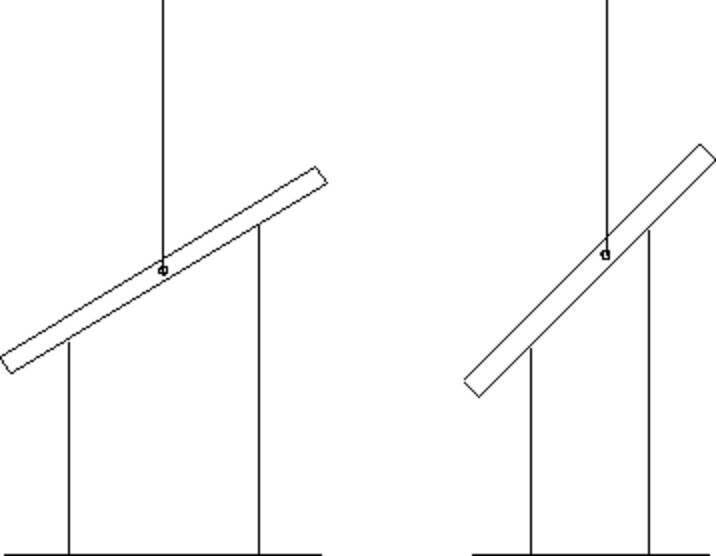
Wertheimer on understanding
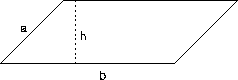
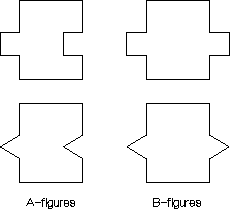
Transfer problems
Kye's method (Ginsberg, "Children's arithmetic")
 64
-28
---
Teacher: "You can't take 8 from 4, so ..."
Kye: "Oh, yes you can. 4 minus 8 is negative 4. And 40 and
negative 4 give you 36."
 64
-28
---
 -4
 40
---
 36
Another example from Ginsberg
  16      16+9=25 (counting out)
 + 9
 ---
  15
I: So when we count we get 25 and when we do it this way
we get 15. Is that okay to get two answers or do you
think there should be only one?
S: (Shrugs his shoulders.)
I: Which one do you think is the best answer?
S: 25
I: Why?
S: I don't know.
I: If we had 16 cookies and 9 more, would we have 15 altogether?
S: No.
I: Why not?
S: Because if you counted them together you would get 25.
I: But is this (points to the answer of 15) right
sometimes? or is it always wrong?
S: It's always right.
Perkins and Baron compared
| Perkins | Baron |
|---|
| structure | possibility |
| purposes | goals |
| arguments | evidence |
Summary: Approaches to thinking errors
Insufficient search for alternative models
Heuristics
Naive theories
Failure to understand