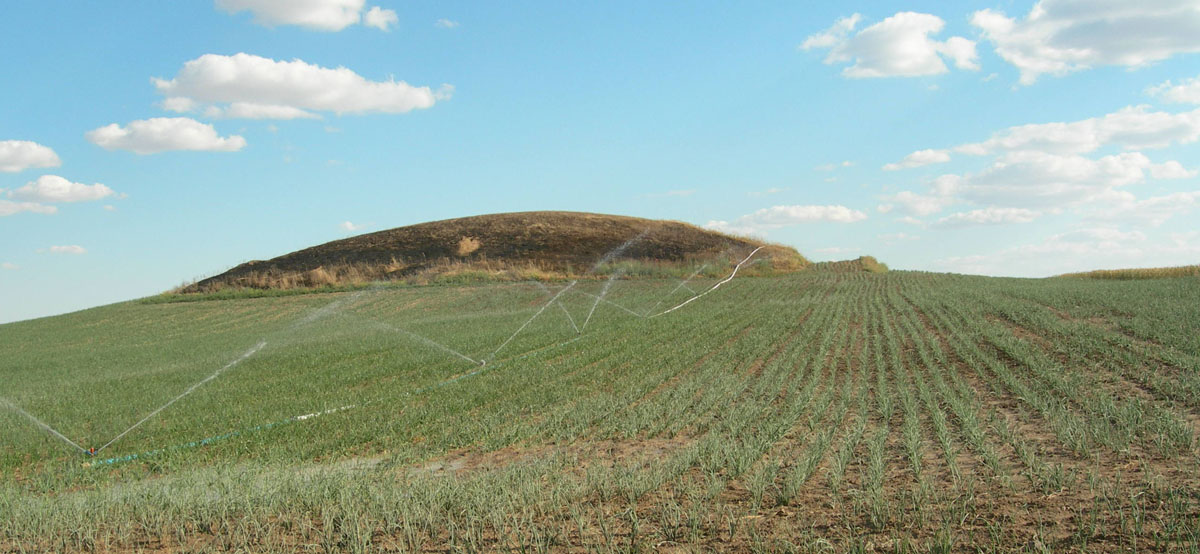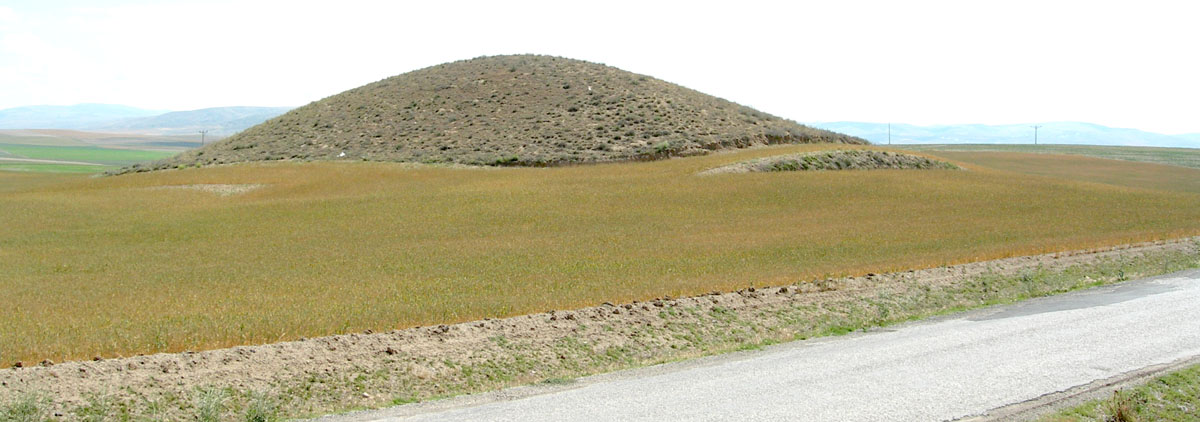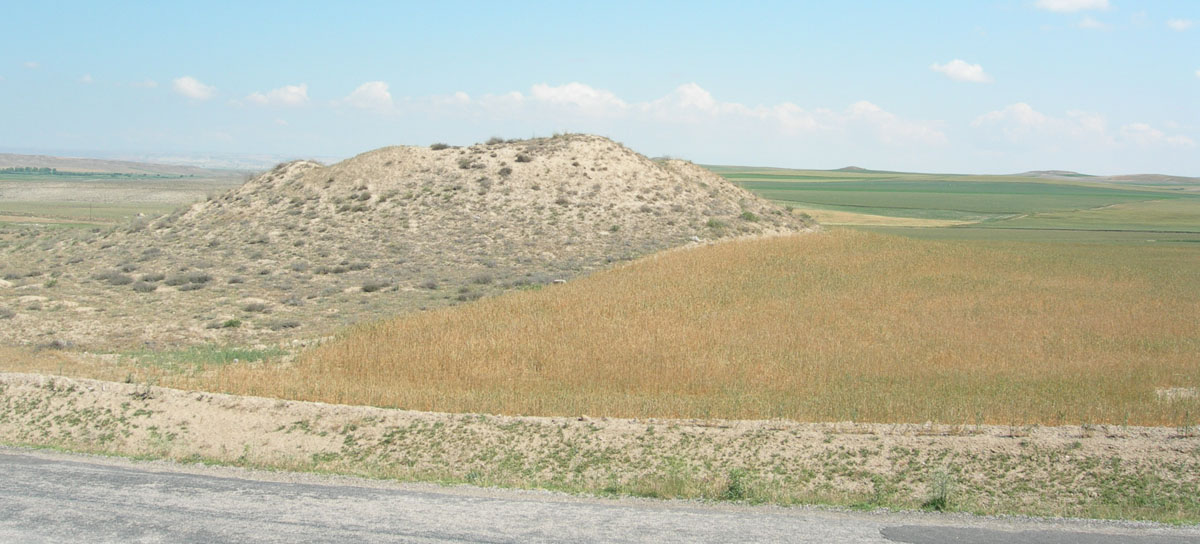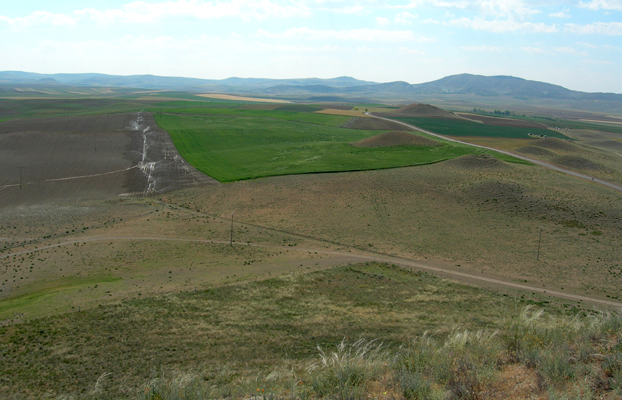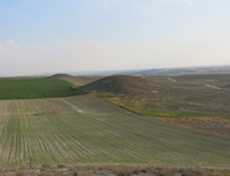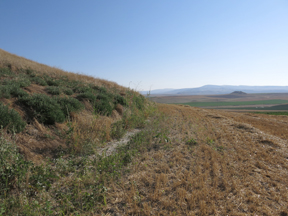
Gordion watercolors:
Gordion Tumulus update: irrigation continues
If you have a couple of hours to kill, there are two Gordion lectures
available on line:
Also, here are some Penn Museum blog posts about Gordion:
Read all about it in Arkeoloji ve Sanat, no. 93 (1999), pp. 12-17
("Erosion, Biodiversity, and Archaeology:
Preserving the Midas Tumulus at Gordion/Erozyon Bioçeşitlilik ve Arkeoloji:
Gordion'daki Midas Höyüğü'nün Korunması")
My Gordion-related publications
Archaeology Miller, Naomi F.
Gordion was the capital of ancient Phrygia
and reputed home of King Midas (c. 800 B.C.). Its monuments include the Midas Mound (Tumulus MM),
over a hundred smaller burial mounds, and the ancient city of Gordion itself. In 1988 and 1989,
excavations directed by Mary M. Voigt concentrated on a deep sounding that uncovered deposits dating
between the Late Bronze Age and the Medieval period. This volume includes discussion of the wood
charcoal and seed data from those excavations. Substantial supporting documentation of the
archaeobotanical remains and the present-day vegetation of the region are duplicated in digital format
on the accompanying CD-rom, which also has some attractive photographs of landscape and plants.
This book provides detailed discussion of and all the archaeobotanical data supporting Miller,
Zeder and Arter (2009), description below.
Miller, Naomi F.
This paper argues that environmental variability has always been a factor in agricultural
decision-making in the Sakarya valley. Rather than the current regime concentrating on irrigation
agriculture, a more sustainable future would include a diversified base of agriculture, animal
husbandry, and ecotourism.
Miller, Naomi F., Melinda A. Zeder, and Susan R.
Arter
Patterning in the archaeobiological remains from Gordion, Turkey,
provides evidence of a continuum in agropastoral
practice. At one end, high ratios of seeds of wild plants vs.
cultivated cereal grains (calculated as count/weight) and high proportions
of the bones of sheep, goat, and deer are signatures of a subsistence
economy focussed on pastoral production. At the other, low wild:cereal
ratios along with high proportions of the bones of cattle, pig, and hare
indicate an economy more focused on agriculture. The highpoint of
agricultural intensification occurs in the Middle Phrygian period, a time
of great wealth, but the norm for the region shows shows that the most
sustainable land use around the ancient settlement
emphasized pastoral production. The signatures for agricultural or
pastoral emphasis is remarkably similar to that seen on sites along the
Euphrates, as reported in MRPS 1997.
Miller, Naomi F. This chapter includes Gordion in the context of a broader
discussion. Miller, Naomi F. Between the Late Bronze Age and the Medieval period, the arboreal
vegetation available to the people of Gordion
changed. Although they always had access to woodland types, there was a
gradual increase in the use of trees of secondary forest (e.g., hawthorn)
and riparian types (e.g., willow/poplar).
Ecopark Miller, Naomi F. This paper explains how an open-air archaeological site is best managed as a kind of
specialized garden. Miller, Naomi F. Miller, Naomi F. and Kurt Bluemel Learn how we set mudbrick to reduce erosion! Miller, Naomi F. Biodiversity preservation and archaeological conservation are
coming together as we develop methods of reducing soil erosion on the
Midas Mound (c. 800 B.C., Gordion, Turkey) by getting native plants to
thrive on the steep slopes of this 53-m high monument. Miller, Naomi F. Miller, Naomi F.
Popular Miller, Naomi F. This book includes many of my Gordion watercolors. Miller, Naomi F., Kimberly E. Leaman, and Julie Unruh The serendipitous discovery that the default shape of a mudball is
biconical inspired research into spindle whorls. It turned out that all
things being equal, center-weighted spindle whorls are most suited fibers
that need more twist; linen fibers need a lot of twist, and the crimped,
scaly fibers of sheep wool need relatively little twist. Early west Asian
ceramic spindle whorls are normally biconical. It may be no coincidence,
therefore, that our first evidence for spindle whorls roughly coincides
with our first evidence for spun fibers, i.e., flax!
Past, Present and Future of the Landscape in the Land of King Midas:
Gordion, Turkey (March 4, 2009, Oriental Institute) and
Gordion: Open-Air Archaeological Site as Garden, Historical
Landscape as Park (March 2, 2011, University of Pennsylvania Museum)
Angora Goats in Yassıhöyük, Turkey, Near Gordion (August 15, 2012)
Suburban Development Threatens Archaeological Site in Gordion, Turkey (August 3, 2012)
National Geographic Visits Gordion (June 15, 2012)
GordionEcopark!
Gordion (ca. 800 B.C.) landscape
reconstruction
Here's a link via Academia.edu to Gordion: Managing an
Open-Air Archaeological Site as a Garden, which is the unabridged version of
"Working with Nature to Preserve Site and Landscape at Gordion," in The Archaeology
of Phrygian Gordion, Royal City of Midas, edited by C. Brian Rose, pp. 243-258.
University of Pennsylvania Museum, Philadelphia (2012).
Plants of Gordion, a work in progress
Mudball: the Movie, an experiment in building
conservation
Penn Museum blog post of Angora goats
2010 Botanical Aspects of Environment and Economy at Gordion,
Turkey. Gordion Special Studies 5.
University of Pennsylvania
Museum, Philadelphia.
If you have the book, but the accompanying CD is corrupted, you can download all the data
and color photos fromthe tDAR 'The
Digital Archaeological Record' website. It's a little tricky to figure out, so don't be
discouraged.
2011 Managing Predictable Unpredictability: The Question of Agricultural
Sustainability at Gordion. In Sustainable Lifeways: Cultural Persistence in an Ever-changing
Environment, eds. N.F. Miller, K.M. Moore, and K. Ryan, pp. 310-324. University of
Pennsylvania Museum, Philadelphia. [Download pdf]
2009 From Food and Fuel to Farms and Flocks: The
Integration of Plant and Animal Remains in the Study of Ancient
Agropastoral Economies at Gordion, Turkey. Current
Anthropology 50: 915-924.
2004 Long-Term Vegetation Changes in the Near East. In The
Archaeology of Global Change. The Impact of Humans on Their
Environment, eds. C.L. Redman, S.R. James, P.R. Fish, and J.D.
Rogers, pp. 130-140. Smithsonian Institution Press, Washington D.C. [Download pdf]
1999 Seeds, Charcoal and
Archaeological Context: Interpreting Ancient Environment and Patterns of
Land Use. TÜBA-AR. 2: 15-27.
[Download pdf]
2012 Working with Nature to Preserve
Site and Landscape at Gordion. In The Archaeology of Phrygian Gordion, Royal City of
Midas, ed. C.B. Rose, pp. 243-258. University of Pennsylvania Museum, Philadelphia.
2000
Plants in the Service of Archaeological Preservation.
Expedition 42(1): 30-36.
1999 Plants and Mudbrick: Preserving the Midas Tumulus at Gordion,
Turkey. Conservation and Management of Archaeological Sites
3: 225-237. [pdf on-line]
1999 Erosion, Biodiversity, and Archaeology: Preserving the Midas Tumulus at
Gordion/Erozyon, bioçeşitlilik ve arkeoloji: Gordion'daki Midas
Höyüğü'nün Korunması. Arkeoloji ve Sanat
93: 13-17 + plate. [Download pdf; see also
Ecopark]
1998 Archaeobotanists Preserve Midas's Wealth.
Anthropology Newsletter 39 (4): 14-15.
1994 Some Botanical Considerations
for the Conservation and Preservation of Tumulus MM at Gordion. In
Anadolu Medeniyetler Müzesi 1993
Yıllığı, Sayı VIII, pp. 181-183.
Ankara.
2002 Drawing on the Past, An Archaeologist's
Sketchbook. University of Pennsylvania Museum, Philadelphia.
To order: call (800) 537-5487 or visit
website.
2006 Serendipity: Secrets of the Mudballs. Expedition
48(3):40-41. And don't miss Mudball: The Movie!
Home Other Gordion links: Gordion Project
Ayşe Gürsan-Salzmann
John (Mac) Marston
Gordion Research Bibliography online